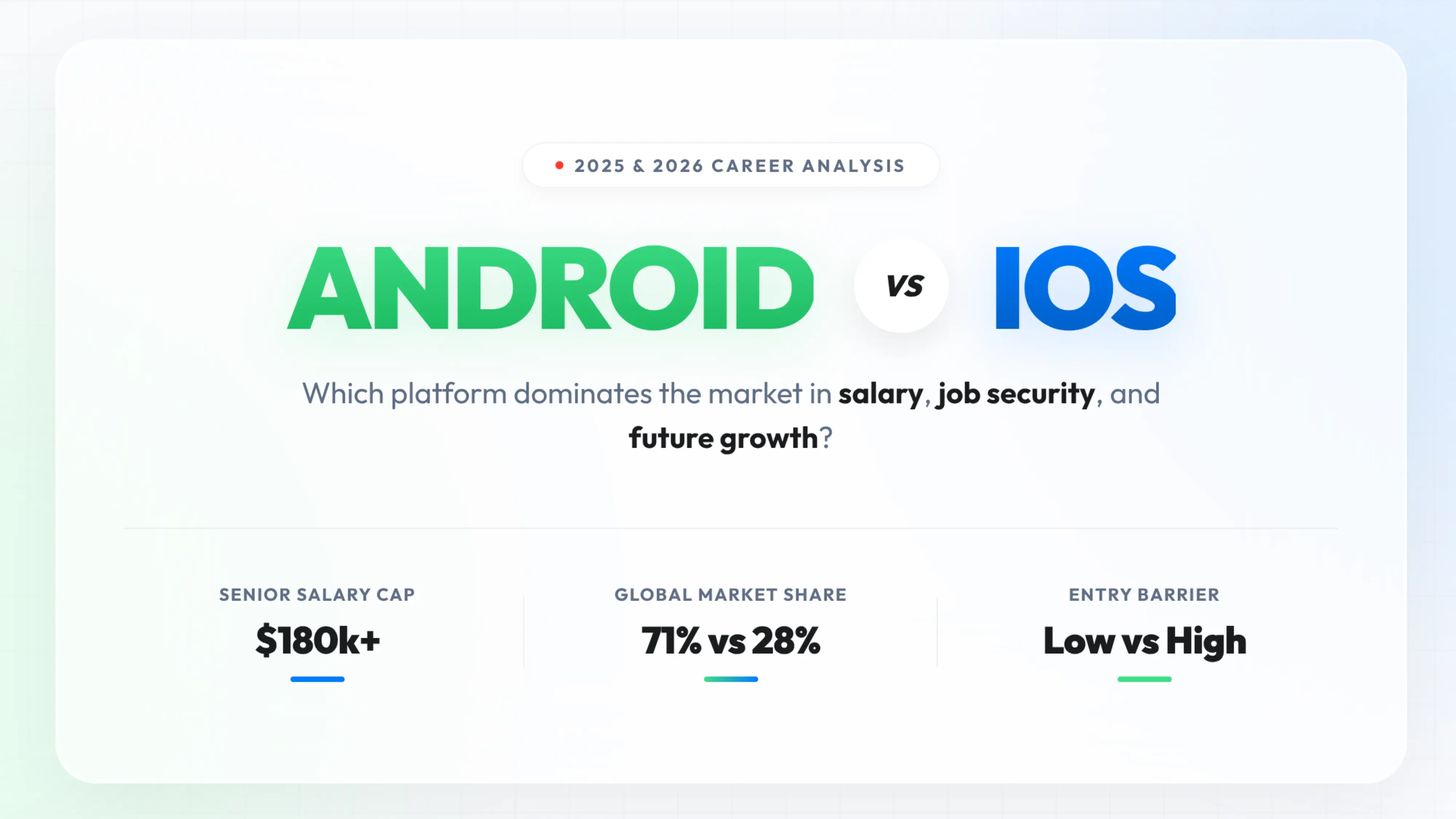
In the fast-paced world of technology, choosing a career path is rarely just about passion. Sure, you might love the freedom of Android or the polished ecosystem of Apple, but at the end of the day, bills need to be paid. The question that keeps aspiring developers awake at night is simple yet complex: Which one pays more?
As we settle into 2025, the mobile development landscape has shifted. We aren't just talking about Java vs. Objective-C anymore. We are talking about an era of AI integration, foldable devices, augmented reality, and cross-platform hybrids. The salary gap between Android and iOS developers has always existed, but the reasons why have changed.
This isn't just a list of numbers; this is a deep dive into the economics of code. We are going to look at salaries, freelance rates, barrier to entry, and the "headache factor" that dictates how much you can charge for your time.
If you are standing at the crossroads of your coding career, sit tight. We are about to break down everything you need to know about the money behind the screen.
1. The 2025 Landscape: A Tale of Two Giants
To understand the paycheck, you first have to understand the playground. In 2025, the duopoly of Google’s Android and Apple’s iOS is stronger than ever, but their philosophies are worlds apart.
The iOS Ecosystem ( The Walled Garden)
Apple has maintained its reputation as a premium brand. Developing for iOS means you are building for a specific, high-spending demographic. The hardware is consistent (mostly iPhones and iPads), the operating system adoption rate is incredibly high (most users are on the latest iOS version), and the tools are proprietary.
The Vibe: Exclusive, polished, strict rules.
The User: Statistically more willing to pay for apps and in-app purchases.
The Android Ecosystem (The Open Field)
Android powers everything from high-end Samsung foldables to budget phones in emerging markets, widespread tablets, and even smart fridges. It is open-source at its core, allowing for immense customization but also introducing "fragmentation"—the developer's nightmare of making an app work on thousands of different screen sizes and OS versions.
The Vibe: Flexible, chaotic, universally accessible.
The User: Vast in numbers, but statistically less likely to pay upfront for software.
Why does this matter for your salary? Because companies know this data. A startup targeting the US market might prioritize iOS because that’s where the immediate revenue is. A company targeting a global user base (like WhatsApp or Uber) needs Android dominance. Your salary is directly tied to how valuable your specific skill set is to that company’s bottom line.
2. The Salary Breakdown: By the Numbers
Let’s get to the meat of the discussion. In 2025, who is taking home the bigger paycheck?
Historically, iOS developers have earned a slightly higher average salary than Android developers. However, the gap is closing, and in some specialized niches, Android is actually overtaking.
Here is a realistic look at the salary tiers based on 2025 global tech trends (figures are estimated averages for the US/Western market, but the ratios apply globally):
Junior Level (0-2 Years Experience)
iOS Developer: $85,000 - $105,000 / year
Android Developer: $80,000 - $100,000 / year
The Insight: At the entry level, iOS tends to pay a premium. Why? Because the barrier to entry is higher (you need a Mac, an iPhone, and patience with Apple's strict guidelines). Fewer people start learning iOS compared to Android, creating a slight scarcity of talent at the junior level. Android development can be learned on a cheap laptop, leading to a flood of entry-level candidates which drives the starting price down slightly.
Mid-Level (2-5 Years Experience)
iOS Developer: $110,000 - $135,000 / year
Android Developer: $108,000 - $132,000 / year
The Insight: At the mid-level, the lines blur. Once you know your way around Kotlin (Android) or Swift (iOS), you are valuable. Companies stop paying for "potential" and start paying for "problem-solving." Here, the salary difference is negligible. It often comes down to the specific company rather than the platform.
Senior Level (5+ Years Experience)
iOS Developer: $145,000 - $180,000+ / year
Android Developer: $140,000 - $175,000+ / year
The Insight: Senior developers are the unicorns. A Senior Android engineer who can handle the fragmentation of 10,000 distinct devices is worth their weight in gold. Similarly, a Senior iOS engineer who understands the deep internals of Swift and memory management is priceless. In 2025, Senior Android devs are seeing massive salary hikes because managing complex Android apps has become arguably harder than iOS, and companies are paying for that expertise.
3. The "Hidden" Costs: ROI on Learning
When calculating "which pays more," you have to subtract what it costs you to get started. This is the Return on Investment (ROI).
The Cost of Becoming an iOS Developer
To be a serious iOS developer, you need Apple hardware.
MacBook Pro: $2,000+
iPhone (for testing): $1,000
Apple Developer Program: $99/year
Total Initial Investment: ~$3,100+
The Cost of Becoming an Android Developer
You can write Android code on almost anything.
Decent Windows/Linux Laptop: $800
Android Device: $200 (or use an emulator)
Google Play Console: $25 (One-time fee)
Total Initial Investment: ~$1,025
The Verdict: Android has a higher initial ROI. You spend less to start earning. However, because the barrier is lower, the competition is fiercer. The "Apple Tax" you pay to be an iOS developer acts as a gatekeeper, ensuring that once you are inside the ecosystem, you face slightly less competition for high-paying roles.
4. Geography Matters: Location, Location, Location
If you are reading this from the United States, the answer is different than if you are reading from India, Pakistan, or Germany.
North America & Western Europe
In the US and UK, the iPhone market share is massive (over 50%). Consequently, companies prioritize "iOS First." High-end startups in Silicon Valley often launch on iOS exclusively before building an Android version.
Winner: iOS. The demand for premium iOS apps in these regions drives salaries up.
Asia, South America, & Africa
In countries like India, Pakistan, Brazil, and Nigeria, Android holds 85% to 90% of the market. Building an iOS-only app here is business suicide. Companies need Android developers to reach the masses.
Winner: Android. While the per-hour rate might be slightly lower than US standards, the volume of work and job security for Android developers in these regions is far superior. You will never run out of work as an Android dev in Asia.
5. Freelancing and Contracting: The Hourly Rate Battle
Not everyone wants a 9-to-5 job. What about the gig economy? Upwork, Toptal, and Fiverr tell a very interesting story in 2025.
iOS Freelancers:
Average Rate: $40 - $120 / hour
Client Type: Often well-funded startups, small businesses looking for a "premium" look, or established brands.
Project Scope: Clients often expect pixel-perfect design and smooth animations.
Android Freelancers:
Average Rate: $30 - $100 / hour
Client Type: E-commerce businesses, utility apps, and local services aiming for mass adoption.
Project Scope: Clients prioritize functionality and device compatibility over flashy animations.
The "Headache" Factor: As a freelancer, time is money.
iOS: You build it, you test it on 3 or 4 iPhones, and it usually works. You bill for 20 hours, you work 20 hours.
Android: You build it, it looks great on a Pixel, but crashes on a Xiaomi, looks weird on a Samsung, and won't open on an Oppo. You bill for 20 hours, but you might spend 5 extra hours debugging specific device issues.
Winner: iOS generally offers a better "money-per-headache" ratio for freelancers. Clients tend to have higher budgets and the development testing cycle is more predictable.
6. The Independent Developer Route: Making Your Own App
What if you don't want a boss or a client? What if you want to build the next Flappy Bird or TikTok?
This is where the difference is stark.
Revenue per User: Apple users spend significantly more money on the App Store than Android users do on the Google Play Store. In fact, despite Android having way more users globally, the App Store generates nearly double the revenue of the Play Store.
If your business model is In-App Purchases (IAP) or Paid Apps: You must go with iOS. It pays drastically more.
If your business model is Ads: You should lean towards Android. You need volume (millions of users) to make ad revenue significant, and Android gives you that reach.
7. The Tech Stack: Swift vs. Kotlin
Your salary is also defined by how enjoyable and efficient the work is. If you burn out, you earn $0.
iOS (Swift & SwiftUI)
Swift has matured into a beautiful, safe, and fast language. With the introduction of SwiftUI, building user interfaces has become incredibly fast. In 2025, Swift is also expanding to server-side development.
Pros: Clean syntax, excellent tooling (Xcode is heavy but powerful), strict architecture.
Android (Kotlin & Jetpack Compose)
Kotlin is modern, expressive, and concise. It fixed the verbosity of Java. Jetpack Compose is Google's answer to SwiftUI, making UI development reactive and fun.
Pros: Very flexible, great IDE (Android Studio is arguably better than Xcode for code editing), huge community libraries.
Who pays more for the skill? Currently, SwiftUI experts are commanding high rates because legacy iOS apps (written in Objective-C or UIKit) are frantically being rewritten in SwiftUI. However, Kotlin Multiplatform (KMP) is the dark horse of 2025. If you know KMP (allowing you to share logic between Android and iOS), you are effectively a "Super Developer" and can name your price.
8. The Cross-Platform Threat (Flutter & React Native)
We cannot talk about mobile dev salaries without addressing the elephant in the room. Why hire two developers (one iOS, one Android) when you can hire one Flutter developer?
In 2025, frameworks like Flutter and React Native are powerful.
React Native/Flutter Salary: $90,000 - $130,000 / year.
The Reality Check: Cross-platform developers earn great money, often matching native developers. BUT, the ceiling is lower. The absolute highest-paid roles (High-Frequency Trading mobile apps, heavy AR/VR apps, complex video editing tools) still require Native development.
If you want the absolute maximum salary possible, you need to be a Native Specialist (deep iOS or deep Android). If you want the most job openings and easier entry, Cross-Platform is the way.
9. Future Trends affecting Pay in 2025 and Beyond
Where is the money moving?
1. AI on Device
With the release of Gemini Nano on Android and Apple Intelligence on iOS, developers who know how to integrate Machine Learning models directly into mobile apps are seeing a salary bump of 15-20%.
Edge: Slightly favors Android right now due to Google's aggressive AI push, but Apple is catching up fast.
2. The Internet of Things (IoT)
Android is the OS of things. Cars, watches, TVs, kiosks. If you want to code for the automotive industry (Android Automotive), that is a massive, high-paying niche that iOS simply doesn't have.
3. Extended Reality (XR)
Apple's Vision Pro ecosystem is growing. iOS developers who learn spatial computing (coding for AR/VR) are entering a market with zero competition and massive paychecks. This is the new "gold rush."
10. Conclusion: The Final Verdict
So, who wins the paycheck war in 2025?
The Winner for Highest Potential Peak Salary: iOS. If you want to work for top-tier US tech companies, build for the luxury market, or get into the lucrative world of spatial computing with Apple Vision Pro, iOS is the winner. The combination of high user spending and a barrier to entry keeps salaries high.
The Winner for Job Volume and Global Flexibility: Android. If you want to work anywhere in the world, have the lowest cost to start your career, and enter emerging industries like Automotive or IoT, Android is the winner.
My Advice as a "Human" Developer: Don't chase the money alone. The salary difference between a good Android dev and a good iOS dev is maybe $5,000 a year. That amount is not worth working on a platform you hate.
Do you like structure, rules, and beautiful design? Choose iOS.
Do you like freedom, customization, and tinkering with hardware? Choose Android.
The developer who gets paid the most is rarely the one who chose the "right" OS. It is the one who mastered their craft, learned how to communicate value, and kept learning when the frameworks changed.
Frequently Asked Questions (FAQ)
Q: Is it harder to learn iOS or Android? A: Android is generally considered slightly harder to master initially due to the complexity of the ecosystem (many devices, screen sizes). However, Swift (iOS) has a stricter learning curve regarding coding standards.
Q: Can I learn both? A: Yes, but not at the same time. Master one first. Once you understand the concepts of mobile development (lifecycles, networking, UI threads), switching to the other is much easier.
Q: Will AI replace mobile developers in 2025? A: No. AI (like Gemini) is a tool that helps developers write code faster. It replaces the "coding monkey" tasks, but it cannot replace the architecture, problem-solving, and creativity required to build a great app.
Q: Which one is better for freelancing? A: iOS usually attracts higher-paying clients, but Android offers a higher volume of jobs.
Disclaimer: Salaries mentioned are averages based on 2025 industry trends and can vary wildly based on your specific location, negotiation skills, and the company’s funding.